Retirement savings for Healthcare professionals aged 30–33 in Seattle
Balances across 401(k), 403(b), IRA and other retirement accounts.
Half of Healthcare professionals aged 30–33 in Seattle have a retirement savings above $4,917. Reaching the upper quarter takes about $64,139, and the top 10% starts at $225,510 — roughly 45.9× the median. The lower quarter sits below $0, and the bottom 10% is under $0.
The full distribution
| Percentile | Retirement savings | What it means |
|---|---|---|
| Bottom 10% | $0 | 9 in 10 are above this |
| Lower quarter | $0 | 25th percentile |
| Median | $4,917 | half above, half below |
| Upper quarter | $64,139 | 75th percentile |
| Top 10% | $225,510 | only 1 in 10 is above this |
Get this cohort's numbers when they move.
One email on the 1st: the median and top-10% retirement savings for Healthcare professionals aged 30–33 in Seattle, what changed since last month, and how many members joined. No account, no spam, one-click unsubscribe.
You'll get the current figures right away, then monthly. Keeping Up Inc, New York. Privacy.
This page is the cohort. An account puts you on it.
- Your rank, kept current. Type a rough figure and your percentile sits on your dashboard, moving as the cohort does.
- Six ranks, not one. Net worth, income, savings rate, spending, retirement and investments against Healthcare professionals aged 30–33 in Seattle.
- Exact when you want it. Connect accounts read-only later for the real number; nothing is required to start.
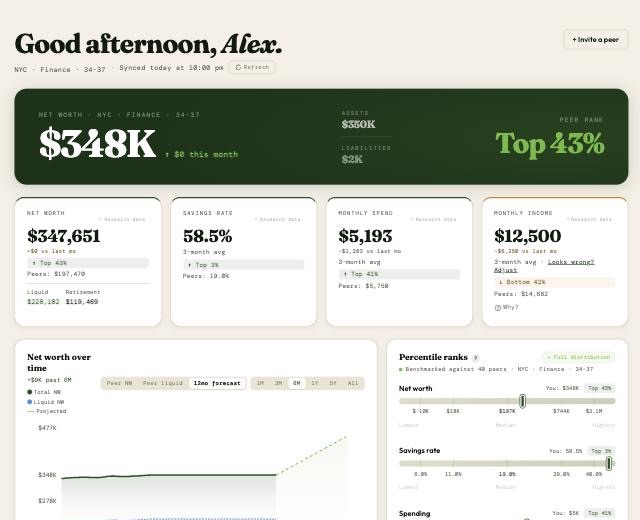
Just want the number? Try the percentile calculator — no signup, and the number you type never leaves your browser.
Retirement savings by age in Seattle
| Age | Lower quarter | Median retirement savings | Upper quarter | Top 10% |
|---|---|---|---|---|
| 22–25 → | $0 | $0 | $6,578 | $33K |
| 26–29 → | $0 | $1,586 | $35K | $106K |
| 30–33 | $0 | $4,917 | $64K | $226K |
| 34–37 → | $0 | $3,806 | $107K | $396K |
| 38–41 → | $0 | $15K | $164K | $599K |
| 42–45 → | $0 | $35K | $253K | $854K |
| 46–50 → | $0 | $51K | $329K | $1.2M |
| 50–54 → | $0 | $49K | $362K | $1.6M |
| 55–59 → | $0 | $54K | $493K | $1.8M |
| 60–64 → | $0 | $60K | $559K | $2.1M |
| 65 and over → | $0 | $0 | $419K | $2.1M |
More for Healthcare professionals aged 30–33 in Seattle
Common questions
How this is built. Percentiles are modeled for this cohort from federal survey microdata — the Federal Reserve's 2025 Survey of Consumer Finances (released October 2026), the BLS Consumer Expenditure Survey (2024), the Census American Community Survey and BLS Occupational Employment & Wage Statistics (May 2025) — with metro cost-of-living and wage adjustments. As Keeping Up members in this cohort grow, the band blends toward anonymized, aggregated live data (minimum cohort sizes apply; no individual is ever identifiable). Seeded figures are household-level, as in the SCF; live cohorts are individual-level. Amounts are in current dollars. Read the full methodology.
Last updated November 2026. Cohort: Healthcare professionals aged 30–33 in Seattle.